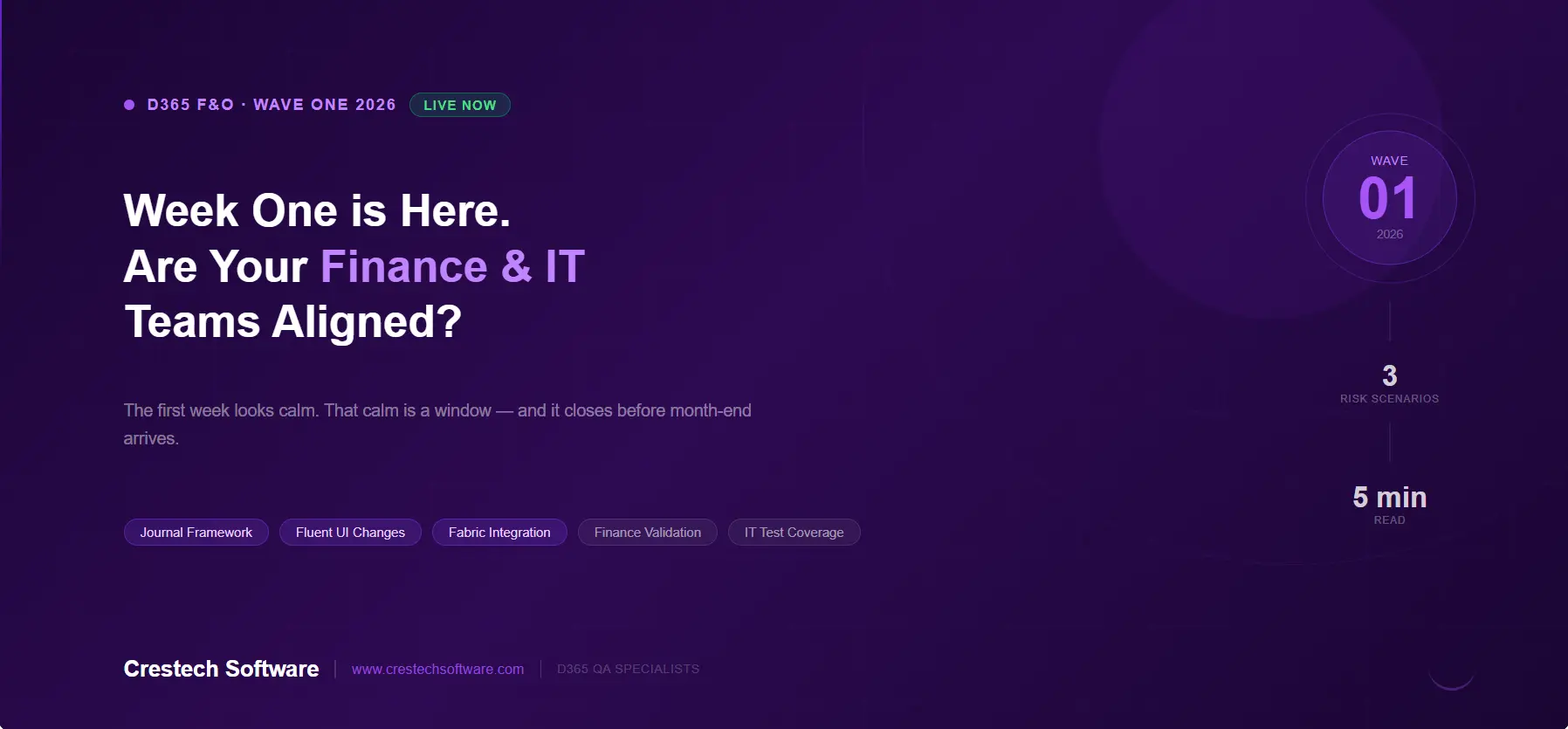
Wave One went live on 1st April 2026. The first week looks calm for most teams. That calm is not a signal to relax — it’s a window that closes fast.
Wave One 2026 is no longer something to prepare for. It’s here. And if your D365 Finance & Operations environment is on the standard Microsoft update schedule, it’s already in your sandbox — or heading there very soon.
Most organisations will experience the same thing in Week One: nothing obviously breaks. Screens load. Transactions post. Users don’t complain. Everyone breathes a quiet sigh of relief and moves on.
That’s the pattern. And it’s also the trap.
The real impact of a release like Wave One doesn’t surface on Day 1. It surfaces when your finance team runs their first month-end close under the new framework. When your warehouse processes its first high-volume dispatch. When your IT team discovers that an integration that’s been running flawlessly for 18 months has silently stopped working correctly.
Week One is not the time to monitor. It’s the time to validate. Here’s how finance and IT teams should be thinking about it differently.
Why Finance and IT Experience Wave One Differently
One of the most common misalignments we see after a major D365 release is that finance teams and IT teams are looking at completely different things — and neither has the full picture.
Finance team view — focused on outputs Finance professionals are watching whether reports balance, whether journal entries post correctly, and whether period-end sequences run as expected. They won’t see a problem until they run a process — and by then it may be too late to fix it before close.
IT team view — focused on stability IT teams are watching whether the system is up, whether integrations are responding, and whether users can log in. They’re monitoring infrastructure — but often not the business logic that runs on top of it. A process can be broken without a single error log.
Wave One 2026 touches both layers simultaneously. The journal framework changes affect finance logic. The Fluent UI redesign affects how IT-managed test scripts and automation behave. The Microsoft Fabric integration updates affect the data layer that both teams rely on. Neither team, working in isolation, will catch everything.
The Three Scenarios We See Most Often in Week One
Scenario 1 — The silent journal shift Wave One’s journal framework update changes how entries behave across legal entities. On the surface, journals post without errors. But the logic behind intercompany allocations or cost centre assignments has shifted slightly. Finance teams don’t notice until reconciliation — two to three weeks later — when the numbers don’t add up and no one can immediately explain why.
Scenario 2 — The broken automation script Wave One’s Fluent UI redesign changes the structure of pages and forms across D365. Automated test scripts or workflows built against specific UI elements — field positions, button labels, navigation paths — break quietly. IT teams don’t know until a scheduled automation run fails, often at the worst possible time.
Scenario 3 — The integration gap Deeper Microsoft Fabric integration in Wave One changes how data moves between D365 and connected systems. Custom reporting tools, third-party applications, and data pipelines that were working fine before the release start returning stale or mismatched data. By the time the discrepancy is noticed, it has already affected downstream reporting or decision-making.
None of these scenarios trigger an obvious alert. They all look like normal operation until a human runs a process that depends on correct behaviour — and finds it isn’t correct anymore.
What Finance Teams Should Do This Week
Don’t wait for month-end to discover a problem with your financial workflows. Use Week One to run a deliberate validation pass across the processes that matter most:
Run a test journal cycle now — post a set of intercompany journal entries and verify the output matches expected behaviour. Check GL account assignments, cost centre allocations, and legal entity handling specifically. Any discrepancy here is far easier to investigate in Week One than in the middle of close.
Validate your period close sequence — walk through the steps your team will follow at month-end and confirm each one behaves as expected. Pay particular attention to subledger to ledger reconciliation and any automated posting rules.
Check compliance-sensitive outputs — if your organisation generates regulatory reports or audit-ready financial data from D365, run a sample report now and compare it against a pre-Wave One baseline. Any structural change to report output is better found today than at submission time.
What IT Teams Should Do This Week
Infrastructure stability is not the same as process stability. Use Week One to go beyond uptime monitoring:
Audit your automation scripts against the new UI — any test scripts or workflow automations that interact with D365 screens need to be reviewed for Fluent UI compatibility. Scripts that worked before the release may silently fail now. Run them in a controlled environment before they run in production.
Verify integration endpoints under real conditions — don’t just check that APIs are responding. Verify that the data being returned is correct and complete. Wave One’s Fabric integration changes can affect what data is available and when — especially for real-time reporting and analytics tools.
Document what you find — even small things — any anomaly observed in Week One, however minor, should be logged. Small behavioural changes in Week One become difficult-to-trace issues in Week Four. A documented baseline now is invaluable when something goes wrong later.
The Conversation That Needs to Happen Between Finance and IT Right Now
Wave One is the kind of release that exposes the gap between how IT thinks the system is working and how finance actually uses it. The teams that handle these releases best are the ones where both functions are in the same room — or at least the same conversation — during Week One.
A 30-minute cross-functional check-in this week, where finance walks IT through the workflows they depend on most and IT confirms which of those are at highest risk from the changes in this release, is worth more than any amount of post-incident analysis.
At Crestech, this is precisely the kind of structured, cross-functional validation we facilitate for D365 teams — making sure that the people who understand the business processes and the people who manage the technology are both looking at the same picture before a release lands.
If your team hasn’t had that conversation yet — Week One is still the right time. Just not for much longer.
Need help structuring your Wave One validation this week? We offer a focused QA health check for D365 F&O teams — designed to surface risk across finance and IT layers before it becomes a problem. No obligation, just clarity.
Visit us at www.crestechsoftware.com
Tags: #D365WaveOne2026 #Dynamics365 #D365FnO #FinanceAndOperations #MicrosoftDynamics #ERPTesting #QAReadiness #D365Finance #ReleaseValidation #CrestechSoftware


