The release that will silently break hundreds of process intersections in your production environment
The Reality Check Nobody Wants to Hear
Every year, Microsoft rolls out two major release waves for Dynamics 365 Finance & Operations. And every year, a significant number of businesses go into that release underprepared — not because they don’t care, but because it’s genuinely hard to know where the risk actually sits.
Wave One 2026 is different. It brings some of the most sweeping changes in recent memory — touching financial workflows, supply chain planning, warehouse operations, and the underlying integration architecture that connects D365 to the rest of your Microsoft ecosystem.
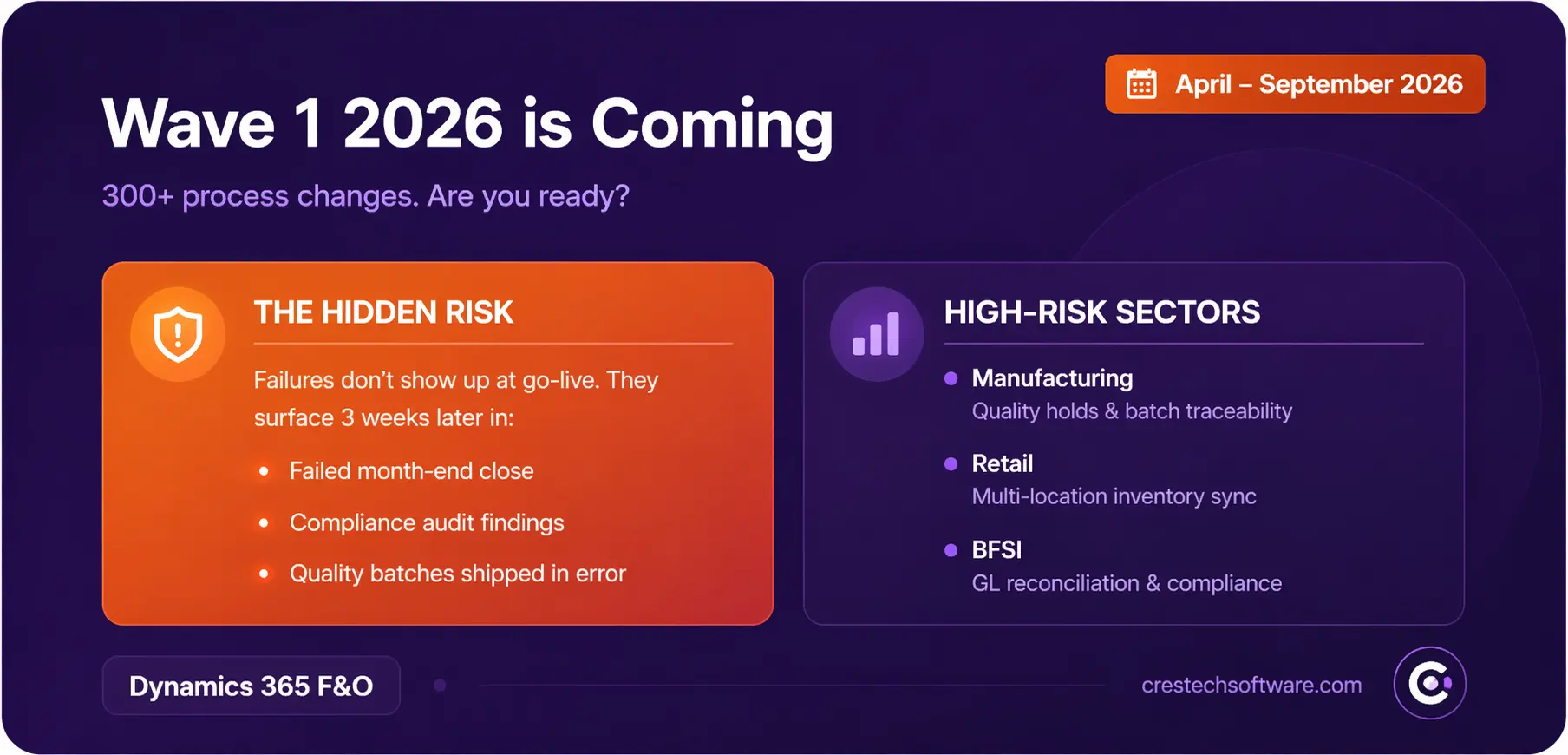
The release plans were published on March 18, 2026. Features roll out progressively between April and September 2026.
What Makes Wave 1 2026 Different
Wave One 2026 is not small. The combination of UI changes, financial framework updates, and supply chain modifications means there are hundreds of process intersections where something can silently break.
And “silently” is the key word.
The headline features include:
🤖 AI-Powered Automation
- Supplier communication agent that autonomously handles procurement workflows
- AI-driven warehouse picking with spatial location intelligence
- Natural language queries for financial data
📊 Supply Chain Enhancements
- Price-demand correlation in planning optimization
- Capacity-to-promise (CTP) date protection
- Dynamic item placement for warehouse efficiency
- Precise serial and batch capture in cluster picking
💰 Financial & Pricing Updates
- API-based pricing calculations for external systems
- Linking pricing decisions to demand forecasts
- Enhanced financial framework changes
📦 Warehouse Management Innovations
- Hands-free scanning capabilities
- Automated dynamic work classification with Power FX
- Integration with external labor management systems
The Silent Killer: When Failures Don’t Show Up at Go-Live
Here’s what most organizations don’t realize: The failure often doesn’t show up at go-live.
It shows up three weeks later in:
- A month-end close that doesn’t balance
- A warehouse dispatch error
- A compliance report that fails audit
- A batch that should have been on quality hold shipping to customers
By then, finding the root cause is painful and expensive.
Industry-Specific Exposure
Different industries face different risk concentrations from Wave One 2026:
🏭 Manufacturing
Supply chain planning changes + quality management updates = production delays if not properly validated. The new CTP date protection and warehouse intelligence features directly impact multi-site manufacturing operations.
Specific risks:
- Quality order workflows intersecting with new batch capture features
- Production planning disrupted by CTP date protection logic
- Multi-site inventory transfers affected by dynamic item placement
🛒 Retail
Supply chain and inventory changes intersect directly with:
- Multi-location stock management
- POS integrations
- Seasonal replenishment cycles
Specific risks:
- Inventory sync failures across store locations
- POS transaction posting errors during high-volume periods
- Stock rebalancing automation breaking existing transfer workflows
💼 Professional Services
Project operations billing + timesheet workflows + financial integrations = revenue recognition delays if untested.
Specific risks:
- Timesheet-to-invoice conversion failures
- Project costing calculations affected by pricing API changes
- Multi-currency billing errors in month-end processing
- Approval workflow breaks in complex organizational hierarchies
🏦 Banking & Financial Services (BFSI)
Journal framework and compliance control updates create risk in:
- GL reconciliation
- Audit reporting
- Period close procedures
Areas where errors have direct regulatory consequences.
Specific risks:
- GL journal posting failures during period-end close
- Regulatory report generation errors
- Audit trail gaps from framework updates
- Compliance control workflows silently bypassed
Why Traditional Testing Approaches Fail
The honest answer? Most organizations don’t have a structured testing process in place for D365 releases.
They rely on a handful of key users to manually click through a few screens, declare it “looks fine,” and push to production.
That approach worked — barely — when releases were smaller.
Wave One 2026 is not small.
The combination of:
- UI changes
- Financial framework updates
- Supply chain modifications
- Warehouse automation
- AI agent integration
…means there are hundreds of process intersections where something can silently break.
The Hidden Cost of “User Acceptance Testing”
When you ask business users to “test the update,” here’s what actually happens:
✅ They check their most common happy-path scenarios
❌ They don’t test edge cases
❌ They don’t test integrations
❌ They don’t test month-end processes (because it’s not month-end)
❌ They don’t test scenarios they perform quarterly
❌ They don’t validate data integrity across modules
The result? A false sense of security that collapses when real business cycles hit the new release.
The Crestech Approach: QA Engineering, Not Click-Testing
At Crestech, we’ve been tracking Wave One 2026 since the early release notes dropped. We don’t believe in a one-size-fits-all testing approach. But we do believe in a structured, repeatable way of building toward release confidence.
Phase 01 — Release Impact Assessment
Before any code is written, we map the release changes to your business processes:
- Which Wave 1 features touch your critical workflows?
- Where are the integration points?
- What are your highest-risk process intersections?
Phase 02 — Automated QA Foundation
We build a reusable test automation suite specifically for D365 F&O:
- 500+ pre-built test assets covering finance, billing, and supply chain
- Process validation across procurement, inventory, order processing
- Integration testing to catch failures before they reach production
- Batch job monitoring because ERP’s heartbeat runs in the background
Phase 03 — Continuous QA Engineering
Once the foundation is stable, we keep building. The automation suite grows with your business, so Wave Two, hotfixes, and custom updates never start from zero.
What makes this work is not just the process — it’s the people.
Our team includes functional experts in supply chain management and financial operations. They understand D365 the way your business users do, not just the way an IT team does.
That combination matters when you’re trying to identify risk in a process, not just a screen.
Real Questions You Should Be Asking Right Now
For Your CFO:
❓ “How will we know if Wave 1 breaks our month-end close process before we discover it during actual month-end?”
For Your Supply Chain Director (Manufacturing/Retail):
❓ “With AI-powered picking and dynamic item placement rolling out, how do we validate these don’t disrupt our existing warehouse workflows?”
For Your Finance Director (Professional Services):
❓ “When the pricing API changes, how do we ensure our project billing and timesheet workflows still calculate correctly?”
For Your Compliance Officer (BFSI):
❓ “When the journal framework updates, how do we prove our GL reconciliation and regulatory reporting processes still meet audit requirements?”
For Your IT Director:
❓ “Do we have automated regression testing, or are we relying on users to manually validate 300+ process scenarios?”
The Uncomfortable Truth About D365 Release Cycles
Microsoft’s release cadence isn’t slowing down.
2026 Wave 1 (April-September 2026) is followed immediately by 2026 Wave 2 (October 2026-March 2027).
If you’re still recovering from the last update when the next one arrives, you’re permanently behind.
The organizations that thrive in this environment are the ones that treat release validation as a continuous capability, not a quarterly fire drill.
What You Can Do Right Now
✅ Step 1: Assess Your Risk Exposure
Which Wave 1 features affect your critical business processes? Don’t wait for Microsoft to force the update — map it now.
✅ Step 2: Audit Your Current Testing Approach
Are you relying on manual testing? How many scenarios can your team realistically validate before go-live?
✅ Step 3: Build Release Readiness Into Your DNA
Automated QA isn’t a project — it’s a permanent capability. The test suite you build for Wave 1 becomes your foundation for Wave 2.
✅ Step 4: Get Expert Help
If you don’t have D365 functional experts who understand both the technology AND your industry’s compliance requirements, you’re flying blind.
Final Thought: The Cost of “We’ll Deal With It Later”
Three weeks after Wave 1 goes live, when:
- Your month-end close fails
- Your warehouse picks the wrong inventory location
- Your project billing calculation is incorrect
- Your audit report doesn’t balance
…the cost of fixing it will be 10x what proper testing would have cost.
The question isn’t whether you can afford to invest in proper QA for Wave 1 2026.
The question is whether you can afford NOT to.
Ready to Stop Gambling With Your D365 Updates?
Crestech offers a no-obligation QA readiness assessment specifically for D365 Finance & Operations — designed to give you a clear picture of your release exposure before Wave One lands.
We help organizations:
✅ Identify high-risk process intersections
✅ Build automated regression testing suites
✅ Validate integrations before production
✅ Achieve faster, safer releases with 70%+ reduction in manual testing effort
Don’t let Wave One 2026 be the update that breaks in production.
📞 Contact Crestech Software
Website: www.crestechsoftware.com
Schedule Your QA Readiness Assessment → Transform your D365 testing from reactive fire-fighting to proactive engineering.
About Crestech Software
For 20+ years, Crestech has helped 400+ clients across Manufacturing, Retail, BFSI, and Professional Services launch flawless software by catching defects early. Our QA expertise in D365 F&O ensures speed, cost efficiency, and enterprise-grade reliability.
Testing for the best, with the best, to deliver the best.
#Dynamics365 #D365 #MicrosoftDynamics #FinanceAndOperations #SupplyChain #QATesting #TestAutomation #EnterpriseERP #Wave12026 #DigitalTransformation