Every year, Microsoft rolls out two major release waves for Dynamics 365 Finance & Operations. And every year, a significant number of businesses go into that release underprepared — not because they don’t care, but because it’s genuinely hard to know where the risk actually sits.
Wave One 2026 is no different. In fact, it brings some of the most sweeping changes in recent memory — touching financial workflows, supply chain planning, warehouse operations, and the underlying integration architecture that connects D365 to the rest of your Microsoft ecosystem.
At Crestech, we’ve been tracking Wave One since the early release notes dropped. This article shares what we see, what we think organisations should be doing right now, and how different industries need to think about their exposure.
What’s actually changing in Wave One 2026
The headline features are well-documented on Microsoft’s release plan pages — but the implications often get lost in translation. Here’s what actually matters:
Copilot in Finance & Operations — Microsoft is embedding AI-assisted capabilities directly into financial workflows. Journal entries, anomaly flags, and process suggestions will behave differently for users. Any automated test scripts or workflows built around these screens will need to be reviewed and updated.
Modernised journal and multi-entity framework — Changes to how journals are processed across legal entities. For businesses running complex intercompany accounting, this is a high-risk area. Even small changes here can ripple into reconciliation, period close, and reporting.
Supply chain and warehouse management upgrades — Enhanced demand forecasting, improved production order management, and warehouse process changes. Businesses running JIT, MRP, or multi-warehouse operations need to validate these carefully before go-live.
Microsoft Fabric integration improvements — Deeper data connectivity between D365 and Fabric for real-time analytics. This touches custom integrations, APIs, and data pipelines that many businesses have built on top of the platform.
Fluent UI design updates — The updated interface changes how pages, forms, and navigation elements look and behave. Automated test scripts that rely on UI selectors will break if not updated ahead of the release.
Why businesses get caught off guard
The honest answer? Most organisations don’t have a structured testing process in place for D365 releases. They rely on a handful of key users to manually click through a few screens, declare it “looks fine,” and push to production.
That approach worked — barely — when releases were smaller. Wave One 2026 is not small. The combination of UI changes, financial framework updates, and supply chain modifications means there are hundreds of process intersections where something can silently break.
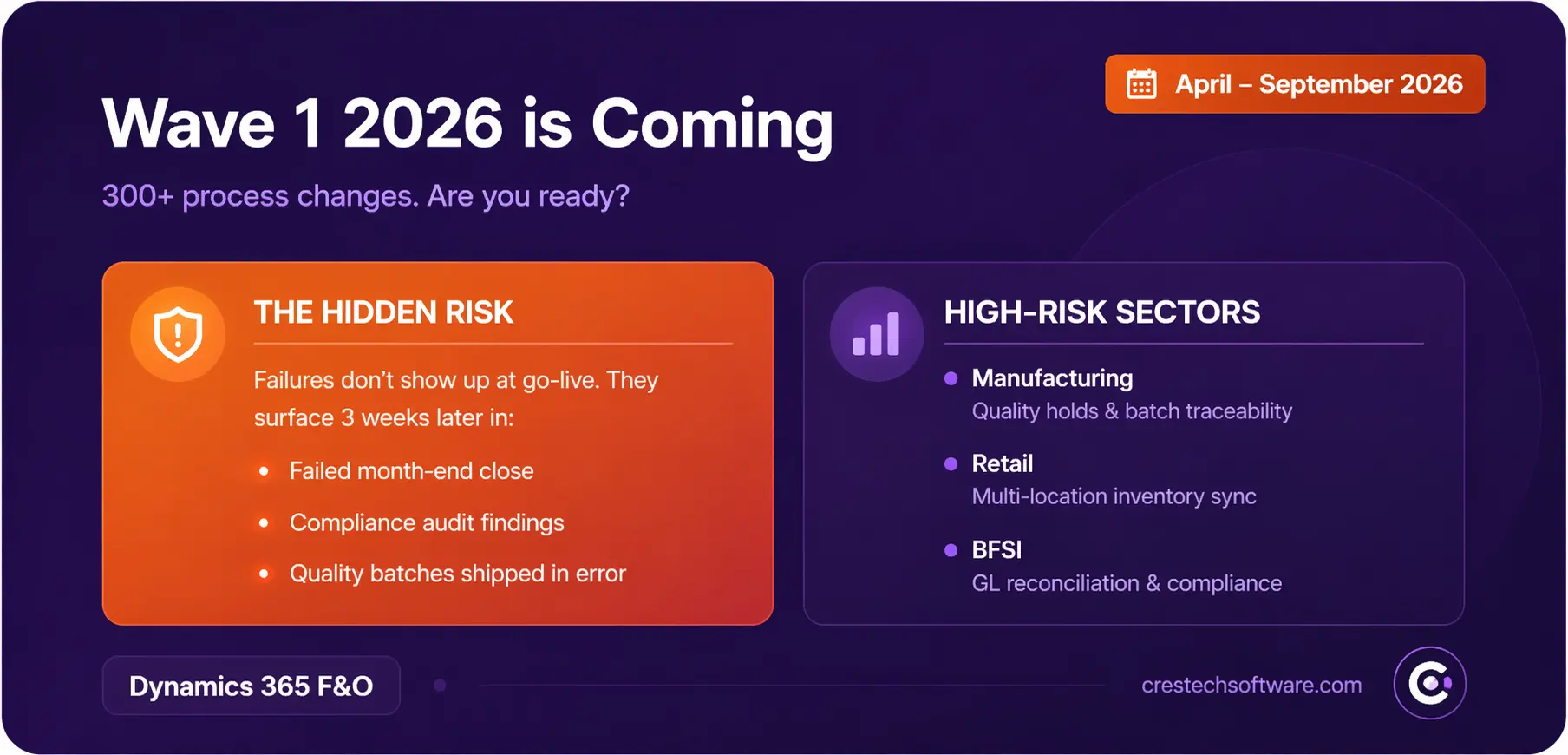
And “silently” is the key word. The failure often doesn’t show up at go-live. It shows up three weeks later, in a month-end close, a warehouse dispatch error, or a compliance report that doesn’t balance. By then, finding the root cause is painful and expensive.
How we think about Wave One readiness at Crestech
We don’t believe in a one-size-fits-all testing approach. But we do believe in a structured, repeatable way of building toward release confidence. Our process has three phases:
Phase 01 — QA readiness assessment We map your current testing landscape — what’s automated, what’s manual, where the gaps are, and which processes carry the highest risk from Wave One changes.
Phase 02 — Regression suite build We identify your core business processes and build a structured regression suite around them — so every future release can be validated quickly and with confidence.
Phase 03 — Continuous QA engineering Once the foundation is stable, we keep building. The automation suite grows with your business, so Wave Two, hotfixes, and custom updates never start from zero.
What makes this work is not just the process — it’s the people. Our team includes functional experts in supply chain management and financial operations. They understand D365 the way your business users do, not just the way an IT team does. That combination matters when you’re trying to identify risk in a process, not just a screen.
What this looks like across industries
Wave One doesn’t hit every business the same way. Here’s where we see the highest concentration of risk by sector:
Retail — Supply chain and inventory changes in Wave One intersect directly with multi-location stock management, POS integrations, and seasonal replenishment cycles.
BFSI — Journal framework and compliance control updates create risk in GL reconciliation, audit reporting, and period close — areas where errors have regulatory consequences.
Manufacturing — Production order management and MRP changes can disrupt BOM processing, procurement cycles, and warehouse dispatch in ways that don’t surface until operations are affected.
Professional Services — Project accounting and resource management updates touch billing milestones, revenue recognition, and time & expense workflows — all critical to client delivery and financials.
The question worth asking right now
If Wave One goes live tomorrow, how confident are you that your most critical business processes will still work exactly as they should?
If the answer is “fairly confident” or anything less than certain — that’s the conversation worth having now, not after go-live.
Preparation doesn’t have to be complex. It has to be structured. And it has to start before the release, not after it.
We offer a no-obligation QA readiness assessment specifically for D365 Finance & Operations — designed to give you a clear picture of your release exposure before Wave One lands. Visit us at www.crestechsoftware.com to learn more about how we work.
Crestech Software Private Limited | www.crestechsoftware.com #D365WaveOne #Dynamics365 #FinanceAndOperations #QATesting #ReleaseReadiness #MicrosoftDynamics